
For countries with highly digital economies such as the United Arab Emirates, understanding the legal implications of cyber warfare is particularly important for national security, economic stability, and the protection of critical infrastructure.
06 March, 2026
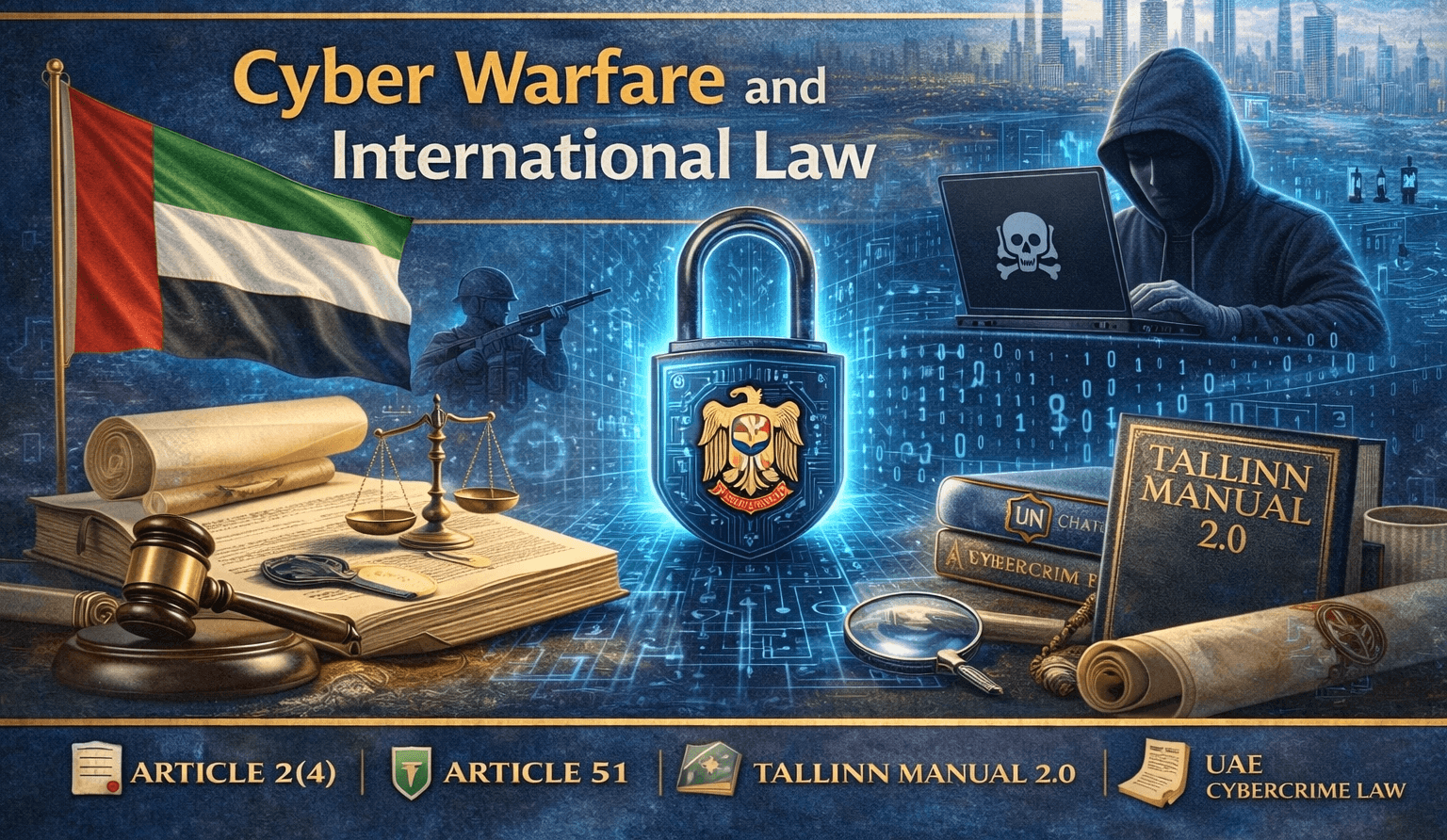
Cyber Warfare and International Law: Legal Frameworks Governing Cyber Operations
Cyber warfare has emerged as one of the most significant security challenges in modern international relations. Cyber operations conducted by states or state-sponsored actors can disrupt critical infrastructure, financial systems, communications networks, and even military operations.
Unlike traditional warfare, cyber attacks may occur without physical weapons yet still produce severe economic, security, and humanitarian consequences. As a result, international law has increasingly adapted to address how existing legal frameworks apply to cyberspace.
The international legal regime governing cyber warfare is primarily derived from the Charter of the United Nations, customary international law, and interpretative frameworks such as the Tallinn Manual 2.0 on the International Law Applicable to Cyber Operations.
For countries with highly digital economies such as the United Arab Emirates, understanding the legal implications of cyber warfare is particularly important for national security, economic stability, and the protection of critical infrastructure.
Prohibition of the Use of Force in Cyberspace
International law generally prohibits states from using force against other states. This rule is established under Article 2(4) of the Charter of the United Nations.
Article 2(4) provides that states must refrain from the threat or use of force against the territorial integrity or political independence of any state.
Although the UN Charter was drafted in 1945—long before the emergence of cyber warfare—legal experts widely agree that this prohibition also applies to cyber operations when their scale and effects are comparable to conventional military attacks.
For example, a cyber attack that:
disables a national electricity grid
disrupts hospital systems
causes physical damage to infrastructure
results in loss of life
may be considered a use of force under international law.
Right of Self-Defence Against Cyber Attacks
States may respond to cyber attacks under the right of self-defence recognized in Article 51 of the UN Charter.
Article 51 provides that states possess an inherent right of individual or collective self-defence if an armed attack occurs.
If a cyber operation reaches the threshold of an armed attack—for example, by causing major destruction or casualties—a victim state may lawfully take defensive measures.
However, the principles governing self-defence remain the same as in traditional warfare:
Necessity – defensive action must be required to stop the attack
Proportionality – the response must not exceed what is necessary to neutralize the threat
These principles form part of customary international law and apply equally to cyber operations.
State Responsibility and Attribution in Cyber Operations
One of the most complex issues in cyber warfare is determining who is responsible for the attack.
Under international law, a cyber operation may trigger state responsibility when:
The conduct is attributable to a state or its agents; and
The act breaches an international obligation.
These principles are reflected in the Articles on Responsibility of States for Internationally Wrongful Acts adopted by the United Nations International Law Commission.
However, cyber operations often involve anonymous actors, proxy groups, or sophisticated techniques designed to hide the origin of the attack, making attribution legally and technically difficult.
The Tallinn Manual and Cyber Warfare Rules
One of the most influential legal studies on cyber warfare is the Tallinn Manual 2.0 on the International Law Applicable to Cyber Operations.
Prepared by an international group of legal experts, the manual analyzes how existing international law applies to cyber operations and provides 154 rules covering state conduct in cyberspace.
The manual confirms several important principles:
Cyber operations are subject to international law.
Sovereignty applies in cyberspace.
Cyber attacks may constitute a use of force depending on their scale and consequences.
States may respond to cyber attacks under the right of self-defence.
Although the manual is not legally binding, it is widely used by governments, military institutions, and international lawyers as an authoritative reference on cyber warfare law.
UAE Legal Perspective on Cybersecurity
For the United Arab Emirates, cybersecurity is both a national security priority and a legal compliance issue.
Domestically, cybercrime and cyber attacks are regulated under UAE Federal Decree‑Law No. 34 of 2021 on Combating Rumours and Cybercrimes, which criminalizes activities such as:
unauthorized access to electronic systems
interference with government networks
cyber fraud and digital espionage
dissemination of false information through online platforms
The UAE has also established several national cybersecurity initiatives, including policies aimed at protecting critical infrastructure, government networks, and financial systems.
Given the UAE’s role as a regional financial and technological hub, cyber threats targeting infrastructure, banking systems, aviation, and energy sectors may also raise questions under international law when linked to cross-border cyber operations.
Relevance for Businesses and Institutions in the UAE
Cyber warfare and state-sponsored cyber operations do not only affect governments. Businesses operating in highly digital economies may also face significant legal and operational risks.
Companies in sectors such as finance, telecommunications, logistics, and energy may become indirect targets of cyber operations during geopolitical conflicts.
Organizations operating in the UAE should therefore ensure compliance with cybersecurity regulations and adopt strong digital risk management frameworks to mitigate potential legal exposure.
Key Takeaways
Cyber warfare is increasingly regulated by existing international legal frameworks.
Article 2(4) of the UN Charter prohibits the unlawful use of force, including cyber operations with destructive effects.
Article 51 of the UN Charter allows states to respond to cyber attacks through self-defence if they reach the threshold of an armed attack.
Attribution and state responsibility remain major challenges in cyber warfare investigations.
The Tallinn Manual provides detailed expert guidance on how international law applies to cyber operations.
The UAE addresses cyber threats domestically through Federal Decree-Law No. 34 of 2021 on Cybercrimes.
Read more articles

Abu Dhabi Business Setup 2026: Licensing, Approvals and New Reforms
Learn how Abu Dhabi is working to accelerate business establishment and operations through licensing reforms, TAMM digital services and coordinated government approvals.
17 October, 2026

UAE Anti-Commercial Fraud Law 2026: Product Withdrawal Rules
Learn about UAE Cabinet Resolution No. 107 of 2026, including the 24-hour product withdrawal deadline, 48-hour public notice requirement and compliance duties for suppliers.
15 October, 2026

UAE Intellectual Property Fee Exemptions 2026: Cabinet Resolution No. 136
Learn how UAE Cabinet Resolution No. 136 of 2026 exempts student inventors and People of Determination from selected patent, industrial design and other intellectual property service fees.
14 October, 2026