Official statements issued by the UAE Ministry of Foreign Affairs frequently demonstrate how diplomatic mechanisms are used to condemn unlawful acts, de-escalate tensions, and reaffirm international legal norms.
06 March, 2026
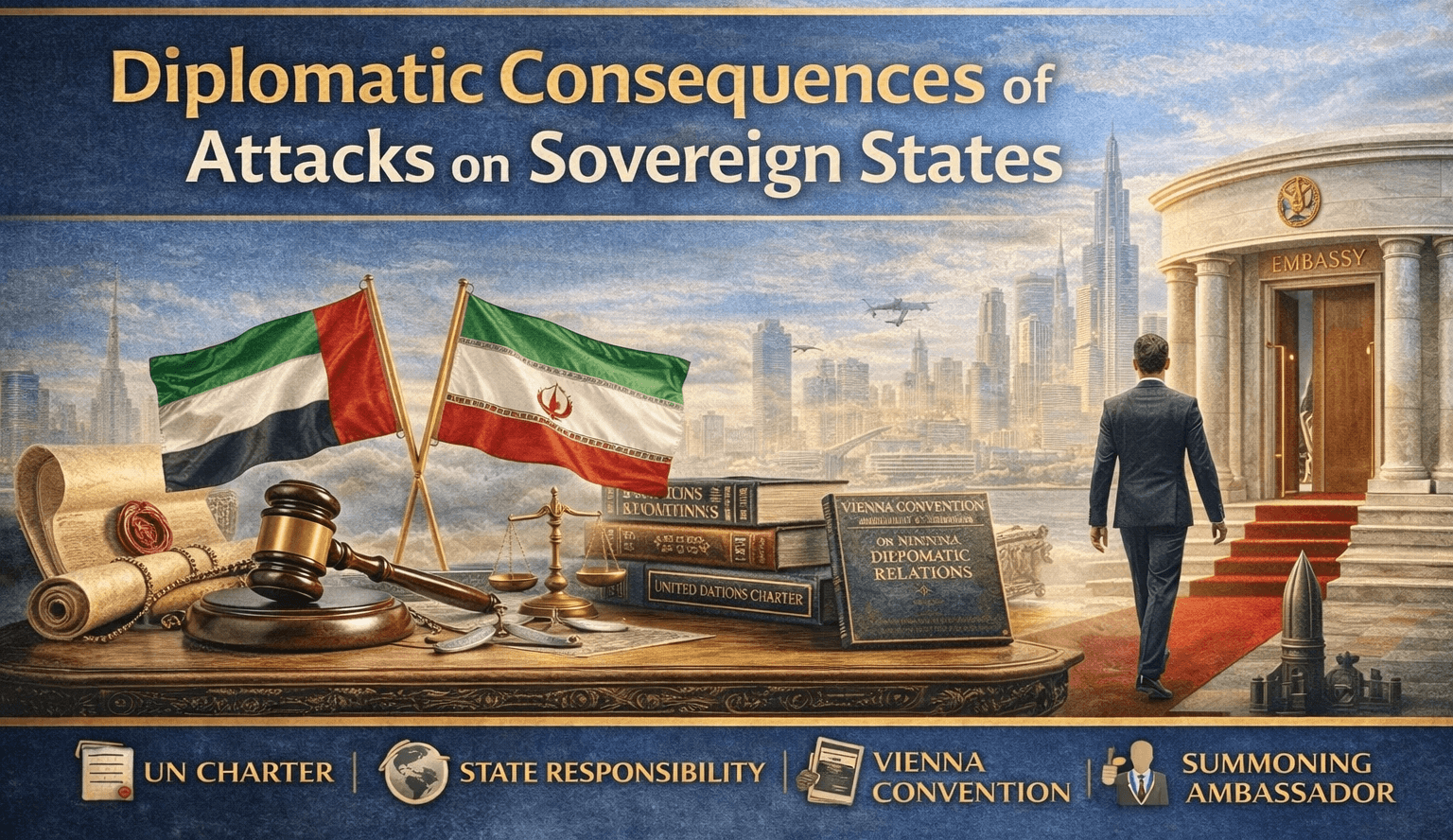
Diplomatic Consequences of Attacks on Sovereign States Under International Law
When attacks occur against sovereign states, governments typically respond not only through security measures but also through formal diplomatic channels. These responses play a critical role in maintaining international legal order and addressing violations of sovereignty.
Official statements issued by the UAE Ministry of Foreign Affairs frequently demonstrate how diplomatic mechanisms are used to condemn unlawful acts, de-escalate tensions, and reaffirm international legal norms.
International law provides a structured framework governing diplomatic responses between states, particularly through treaties regulating diplomatic relations, state responsibility, and peaceful dispute resolution.
Sovereignty and Non-Intervention Under the UN Charter
The legal foundation for diplomatic responses begins with the protection of state sovereignty under the Charter of the United Nations.
Article 2(4) of the Charter prohibits states from using force against the territorial integrity or political independence of another state. When such violations occur, affected states may respond through diplomatic protest, international engagement, or multilateral forums.
Diplomatic responses therefore serve as an initial legal step in asserting a violation of international law before pursuing further remedies.
Diplomatic Protests and State Responsibility
When a state believes that another state has violated international law, it may issue a formal diplomatic protest.
A diplomatic protest may include:
official public statements condemning the act
delivery of formal diplomatic notes
summoning the ambassador of the concerned state
requesting clarification or assurances
These measures are significant because they formally record the injured state's position under international law and may contribute to establishing state responsibility for internationally wrongful acts.
The legal framework governing such responsibility is reflected in the principles contained within the Articles on Responsibility of States for Internationally Wrongful Acts adopted by the United Nations International Law Commission.
Under these principles, a state that commits an internationally wrongful act may be required to:
cease the unlawful conduct
provide assurances of non-repetition
offer reparation or compensation where appropriate
The Vienna Convention on Diplomatic Relations
Diplomatic engagement between states is primarily governed by the Vienna Convention on Diplomatic Relations (1961), one of the most widely accepted treaties in international law.
The Convention establishes the legal framework for diplomatic interaction, including:
the establishment of diplomatic missions
protection of embassy premises
privileges and immunities granted to diplomats
communication between governments
One widely used diplomatic mechanism under this framework is the summoning of an ambassador.
When a foreign ambassador is summoned by the host state's foreign ministry, it serves as a formal diplomatic tool used to:
express strong concern or protest
demand explanations regarding specific actions
convey official government positions
Although non-coercive, this measure signals a serious deterioration in diplomatic relations and places the issue formally on record.
Protection of Diplomatic Missions and Personnel
International law also places strict obligations on states to protect diplomatic premises and personnel.
Articles 22 and 29 of the Vienna Convention require host states to ensure:
inviolability of embassy premises
protection of diplomatic staff
prevention of attacks or interference with diplomatic missions
Violations involving embassies or diplomatic personnel can therefore trigger serious diplomatic disputes and potential international legal consequences.
Diplomatic Measures as Conflict Management Tools
Diplomatic responses often function as an early stage in conflict management.
These measures can:
prevent escalation into armed conflict
open channels for negotiation
facilitate mediation by international organizations
preserve legal claims under international law
In many cases, governments coordinate their responses through international bodies such as the United Nations or regional organizations to maintain collective security and diplomatic stability.
Key Takeaways
Attacks against sovereign states often trigger diplomatic responses alongside security measures.
International law protects state sovereignty under the UN Charter.
Diplomatic protests help establish state responsibility for violations of international law.
The Vienna Convention on Diplomatic Relations governs communication and engagement between states.
Summoning ambassadors and issuing formal diplomatic protests are recognised legal tools in international diplomacy.
Read more articles

Abu Dhabi Business Setup 2026: Licensing, Approvals and New Reforms
Learn how Abu Dhabi is working to accelerate business establishment and operations through licensing reforms, TAMM digital services and coordinated government approvals.
17 October, 2026

UAE Anti-Commercial Fraud Law 2026: Product Withdrawal Rules
Learn about UAE Cabinet Resolution No. 107 of 2026, including the 24-hour product withdrawal deadline, 48-hour public notice requirement and compliance duties for suppliers.
15 October, 2026

UAE Intellectual Property Fee Exemptions 2026: Cabinet Resolution No. 136
Learn how UAE Cabinet Resolution No. 136 of 2026 exempts student inventors and People of Determination from selected patent, industrial design and other intellectual property service fees.
14 October, 2026