
The objective of the law is to ensure safe and healthy living conditions, prevent overcrowding, regulate informal housing practices, and protect the rights of both residents and property owners in Dubai’s real estate market.
13 March, 2026
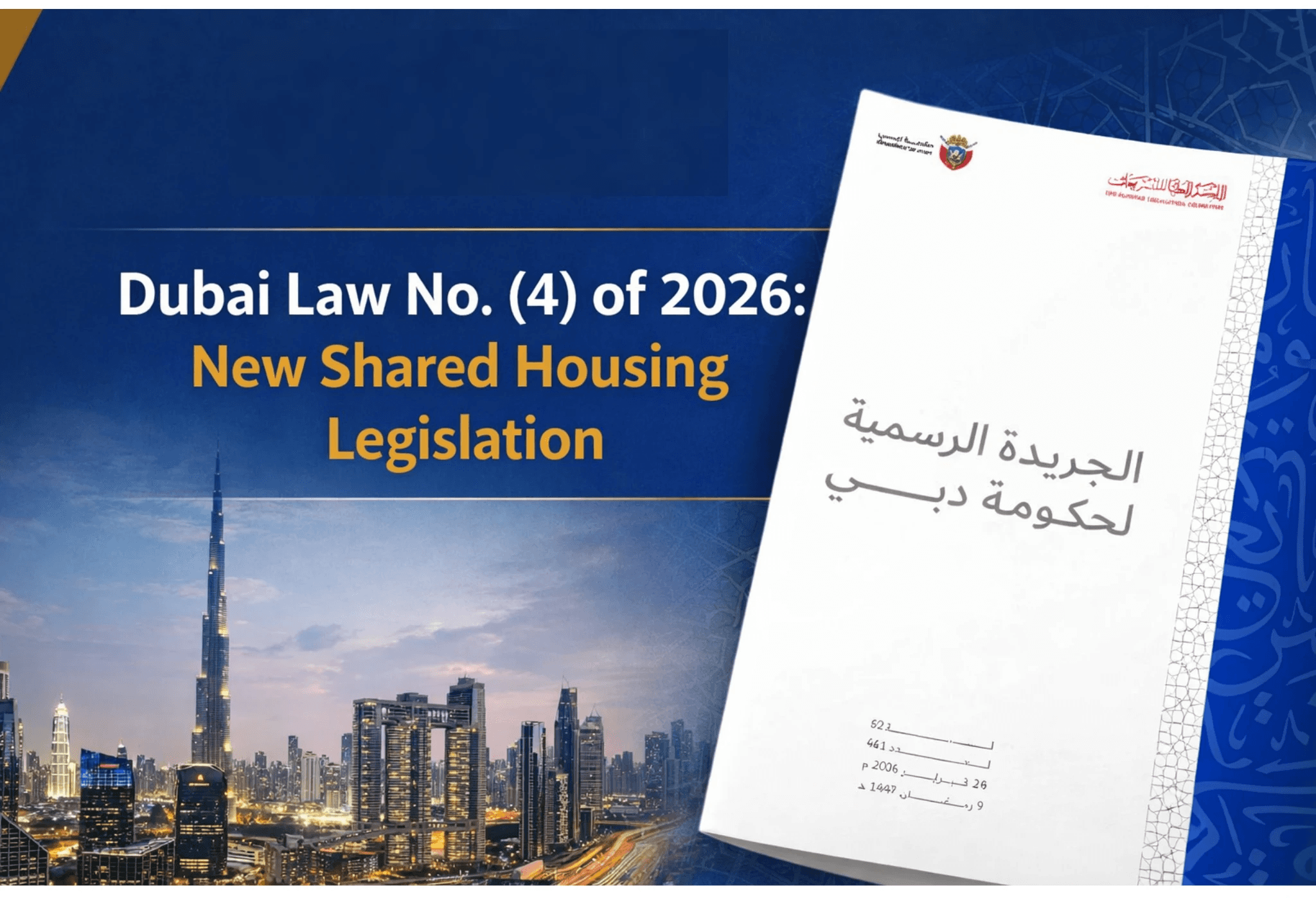
Dubai Law No. (4) of 2026 Regulating Shared Housing Units in Dubai
The Government of Dubai has introduced Dubai Law No. (4) of 2026 regulating the management and occupancy of shared housing units. The law was issued by Mohammed bin Rashid Al Maktoum, Vice President and Prime Minister of the United Arab Emirates and Ruler of Dubai.
The legislation introduces rules governing shared accommodation, bed-space housing, and multi-occupancy residential units across the Emirate. The law applies to property owners, tenants living in shared accommodation, and companies licensed to lease or manage real estate units on behalf of owners.
The objective of the law is to ensure safe and healthy living conditions, prevent overcrowding, regulate informal housing practices, and protect the rights of both residents and property owners in Dubai’s real estate market.
Issuance of the Law and Legislative Authority
Dubai Law No. (4) of 2026 was issued by Mohammed bin Rashid Al Maktoum in his capacity as Ruler of Dubai. The law regulates the management, leasing, and occupancy of shared housing units within the Emirate, including private development zones and free zones.
The legislation forms part of Dubai’s wider efforts to regulate residential accommodation practices and address overcrowding and informal housing arrangements in urban areas.
Authorities Responsible for Implementation
The law assigns responsibilities to key government authorities.
Dubai Municipality
The primary regulatory authority is Dubai Municipality, which is responsible for:
establishing policies for shared housing
determining maximum occupancy levels
defining minimum space per resident
specifying required shared facilities
designating areas where shared housing may be permitted.
These decisions are based on urban planning considerations such as population density, infrastructure capacity, and neighbourhood characteristics.
Dubai Municipality will also manage a unified digital platform to process permits and maintain records relating to shared housing units.
Dubai Land Department
The Dubai Land Department is responsible for maintaining an electronic registry of shared housing units and linking the registry with the municipality’s digital platform.
The department also determines the information required in lease and management contracts, including:
landlord details
number of residents
unit specifications
space allocated to occupants.
Permit Requirement for Shared Housing
Under the new law, no person or company may designate a property as shared housing without obtaining a permit from the relevant authority.
Permits are issued by Dubai Municipality according to rules established by its Director General in coordination with Dubai Land Department and other competent authorities.
Shared housing units must comply with technical standards, including:
maximum occupancy limits
minimum space allocation per resident
building and structural requirements
provision of required shared facilities.
Leasing and Subleasing Rules
The law establishes clear rules regarding who may lease shared housing units.
Shared housing units may be leased:
directly by the property owner
through a company managing the property for the owner
through a company that leases the unit from the owner and subleases it to residents.
However, tenants themselves are prohibited from subleasing any part of the unit, including individual rooms or bed spaces.
This restriction aims to prevent unregulated bed-space arrangements and protect both tenants and property owners.
Technical and Safety Standards
Shared housing units must comply with technical and safety requirements established by the authorities.
These standards include compliance with:
building regulations
fire safety requirements
sanitation and health standards
security requirements
electrical safety regulations.
The law seeks to ensure that shared accommodation maintains safe living conditions and does not create risks associated with overcrowded or improperly partitioned housing.
Administrative Penalties for Violations
The law introduces a system of administrative penalties for violations of shared housing regulations.
Fines may range from AED 500 to AED 500,000, depending on the severity of the violation. Repeat violations within one year may lead to fines of up to AED 1 million.
Authorities may also impose additional measures, including:
suspension of business activities
cancellation of permits
revocation of commercial licences
disconnection of public utilities
eviction from non-compliant units.
Compliance Period
The law provides a transition period allowing existing operators of shared housing to comply with the new requirements.
Property owners and companies already operating shared housing units must bring their properties and operations into compliance within one year.
The law will enter into force 180 days after publication in the Official Gazette of Dubai.
Conclusion
Dubai Law No. (4) of 2026 introduces clear legal rules governing shared housing and multi-occupancy accommodation in the Emirate. The legislation establishes permit requirements, defines occupancy standards, regulates leasing practices, and introduces penalties for violations.
By regulating shared accommodation, the Government of Dubai aims to ensure safe living conditions, prevent overcrowding, and maintain stability in the Emirate’s real estate sector.
Property owners, real estate companies, and residents involved in shared housing arrangements should review the new legal requirements and ensure that their housing practices comply with the provisions of the law.
Read more articles

UAE KYC Digital Platform: Rules, Compliance and Penalties
Understand the UAE National KYC Digital Platform rules under Federal Decree-Law No. 30 of 2024 and Cabinet Resolutions No. 55 and 56 of 2026, including data-sharing duties, consent, confidentiality and administrative sanctions.
23 October, 2026

ADGM Regulatory Priorities 2026–2027: Compliance Guide for Businesses
Explore ADGM’s 2026–2027 regulatory priorities, including annual filings, licence renewals, beneficial ownership, audit quality, AML compliance and consumer protection.
19 October, 2026

Abu Dhabi Business Setup 2026: Licensing, Approvals and New Reforms
Learn how Abu Dhabi is working to accelerate business establishment and operations through licensing reforms, TAMM digital services and coordinated government approvals.
17 October, 2026