
Published in Official Gazette No. 764 (12 March 2026), the law moves beyond technical compliance and introduces a structure where responsibility is distributed, overlapping, and continuous. For developers, contractors, engineering consultants, and property owners, this raises a critical question: where does legal risk ultimately sit?
25 March, 2026
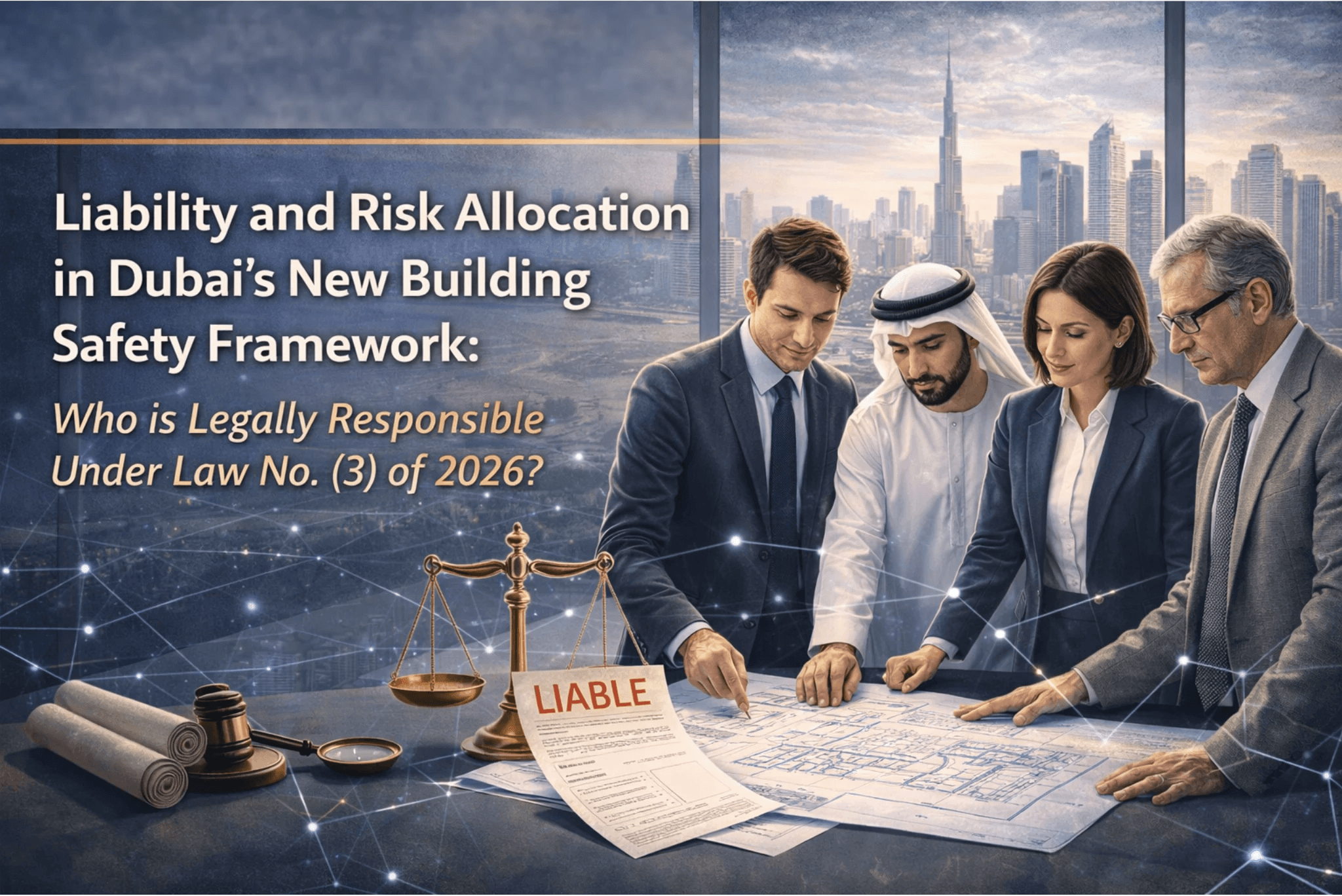
Legal Liability Under Dubai Law No. (3) of 2026: Who Bears the Risk in Building Quality and Safety?
While Dubai Law No. (3) of 2026 on the Quality and Safety of Buildings establishes a comprehensive regulatory framework for the construction and maintenance of buildings, its more significant legal impact lies in how it redefines liability across the real estate lifecycle.
Published in Official Gazette No. 764 (12 March 2026), the law moves beyond technical compliance and introduces a structure where responsibility is distributed, overlapping, and continuous. For developers, contractors, engineering consultants, and property owners, this raises a critical question: where does legal risk ultimately sit?
A Shift from Isolated Responsibility to Concurrent Liability
Traditionally, liability in construction projects has been segmented—developers during development, contractors during execution, and owners post-handover. However, Law No. (3) of 2026 departs from this segmented approach.
Under Articles (6), (7), and (8), compliance obligations are imposed across multiple stakeholders simultaneously. The law requires that buildings adhere to approved designs, technical standards, and safety requirements not only at the point of construction, but throughout their operational life.
This creates a concurrent liability model, where multiple parties may be held responsible for the same issue, depending on its origin. A structural defect, for instance, may trigger liability for the contractor (execution), the consultant (design or supervision), and potentially the developer (overall project delivery).
Developer and Contractor Liability
The law places primary responsibility for construction quality on developers and contractors. Under Article (7), construction must be carried out strictly in accordance with approved designs, technical specifications, and applicable regulations, including the Dubai Building Code (Decree No. 45 of 2021).
From a legal standpoint, this provision does more than impose a compliance obligation—it establishes a direct basis for liability in cases of:
Structural defects
Use of non-compliant materials
Deviation from approved designs
Any such deviation may expose developers and contractors to regulatory action as well as civil claims, particularly where the defect affects safety or usability.
Engineering Consultant Liability
Engineering consultants occupy a critical position within the liability framework. Under Article (8), they are responsible for ensuring the integrity of the design and for supervising construction to ensure alignment with approved plans.
This has two key legal implications. First, consultants may be held liable for design deficiencies, including errors that compromise structural integrity or safety. Second, they may also be exposed to liability for failure in supervision, particularly where non-compliant construction practices go unchecked.
When read alongside Law No. (14) of 2025 regulating engineering consultancy, this creates a heightened standard of professional accountability, increasing the likelihood of claims based on professional negligence.
Post-Handover Liability: Property Owners and Managers
A significant development under the law is the extension of liability beyond construction and into the operational phase. Article (9) imposes obligations on property owners and building managers to ensure that buildings are maintained in accordance with applicable safety standards.
This includes responsibility for maintaining structural integrity, safety systems, and overall building condition. In practical terms, this means that liability for defects or safety failures may shift—or extend—to the owner if the issue arises from poor maintenance, lack of inspection, or failure to comply with operational requirements.
For jointly owned properties, these obligations must be read together with Law No. (6) of 2019, potentially extending responsibility to owners’ associations and management entities.
Regulatory Liability and Enforcement Exposure
The role of the competent authority further reinforces the liability framework. Under Article (10), Dubai Municipality is empowered to monitor compliance, conduct inspections, and take enforcement action where necessary.
This introduces a layer of regulatory liability, distinct from contractual or civil liability. Non-compliance may result in:
Administrative penalties
Orders for rectification
Suspension or restriction of building use
The existence of active regulatory oversight means that liability is not merely reactive (arising after damage), but also preventive and enforceable during the lifecycle of the building.
Where Does the Risk Ultimately Sit?
From a legal perspective, the most important takeaway from Law No. (3) of 2026 is that liability is no longer linear. It does not pass cleanly from one party to another as a project progresses. Instead, it is layered and, in many cases, overlapping.
In practical terms, risk will depend on:
The origin of the defect or non-compliance
The role and obligations of each stakeholder under the law
The contractual arrangements governing the project
This makes contractual structuring critical. Parties must ensure that their agreements clearly define responsibilities, allocate risk appropriately, and include adequate indemnities and protections to address the expanded liability framework.
Conclusion
Dubai Law No. (3) of 2026 fundamentally reshapes the legal landscape for building quality and safety by introducing a model of continuous and concurrent liability. Developers, contractors, consultants, and property owners are no longer insulated within distinct phases of a project, but are instead part of an integrated compliance framework.
For stakeholders across the real estate sector, this requires a shift in approach. Legal risk must now be assessed not only at the point of construction, but across the entire lifecycle of the building. Failure to do so may result in exposure to regulatory action, civil liability, and complex multi-party disputes.
How We Can Assist
At Malhotra Legal Consultancy, we advise clients on navigating liability and risk under Dubai’s evolving construction laws, including Law No. (3) of 2026. Our services include contract structuring, liability assessment, regulatory advisory, and dispute resolution.
For tailored guidance on how this law impacts your projects or portfolio, our team remains available to assist.
Read more articles

UAE Grand Tour 2026: What Travel Agencies and Tour Operators Need to Know
UAE Grand Tour 2026 brings all seven emirates into a single multi-emirate tourism experience. Learn what travel agencies and tour operators need to know about licensing, customer protection and legal requirements.
19 September, 2026

UAE VAT Executive Regulation Amended in 2026: Key Changes Businesses Need to Know
UAE Cabinet Decision No. 149 of 2026 introduces important amendments to the VAT Executive Regulation. Learn about the key VAT changes and their impact on UAE businesses.
17 September, 2026

Dubai Workforce Productivity Measurement System 2026: What Government Entities Need to Know
Dubai adopts a unified Workforce Productivity Measurement System under Executive Council Resolution No. (67) of 2025. Learn about its scope, objectives, data requirements, AI use and impact on Dubai Government entities.
25 August 2026