
Statements issued by the UAE Ministry of Foreign Affairs reaffirm that any defensive measures undertaken by the United Arab Emirates remain aligned with these international legal obligations.
06 March, 2026
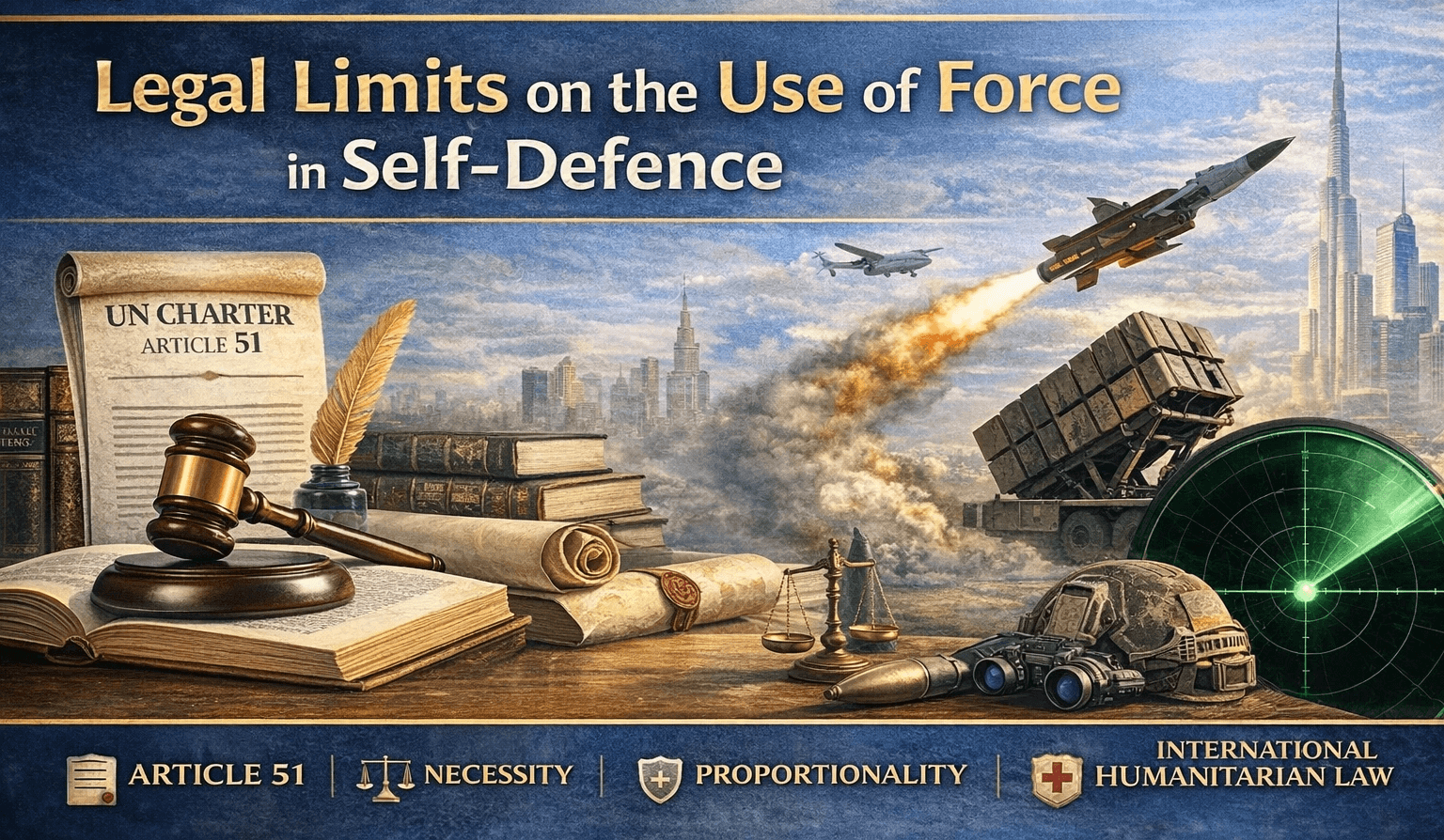
Legal Limits on the Use of Force in Self-Defence Under International Law
International law recognizes that states possess an inherent right to defend themselves against armed attacks. However, this right is not unlimited and must operate within clearly defined legal boundaries established by international treaties, customary international law, and judicial interpretations.
The primary legal foundation for self-defence is Article 51 of the United Nations Charter, which affirms that states may exercise individual or collective self-defence if an armed attack occurs.
However, the use of force must also comply with the broader prohibition on force established under Article 2(4) of the United Nations Charter, which prohibits states from using force against the territorial integrity or political independence of another state.
Statements issued by the UAE Ministry of Foreign Affairs reaffirm that any defensive measures undertaken by the United Arab Emirates remain aligned with these international legal obligations.
Legal Framework Governing Self-Defence
The modern legal framework regulating the use of force by states originates from the Charter of the United Nations, adopted in 1945.
Under this framework:
Article 2(4) establishes a general prohibition on the use of force between states.
Article 51 provides a limited exception allowing states to use force in self-defence when an armed attack occurs.
This exception recognizes that states must retain the ability to protect their sovereignty, territorial integrity, and civilian populations from external threats.
However, Article 51 also imposes procedural obligations. States exercising self-defence must report their actions to the United Nations Security Council, which retains the authority to take measures necessary to maintain international peace and security.
Principle of Necessity
One of the most important limitations on the right of self-defence is the principle of necessity.
This principle requires that defensive force may only be used when it is strictly necessary to repel or prevent an armed attack. If alternative peaceful means such as diplomatic engagement or negotiation could effectively resolve the situation, the use of force may be considered unlawful.
The concept of necessity has been recognized as a rule of customary international law and has been discussed in several international legal precedents, including judgments of the International Court of Justice.
In practice, necessity requires that:
an armed attack must be imminent or ongoing
defensive action must be required to stop the threat
no reasonable peaceful alternatives are available
Principle of Proportionality
Another key limitation on the lawful exercise of self-defence is the principle of proportionality.
Proportionality requires that the scale, scope, and duration of defensive force must be proportionate to the armed attack being addressed. The purpose of defensive force is to neutralize the threat, not to punish or retaliate against the attacking state.
Examples of proportionate defensive measures may include:
interception of incoming missiles or drones
limited defensive strikes against military installations directly involved in the attack
defensive actions aimed at protecting critical infrastructure and civilian populations
If a state’s response exceeds what is reasonably required to stop the attack, the action may violate international law even if the initial use of force was justified.
Protection of Civilians and International Humanitarian Law
Even when self-defence is legally justified, states must comply with the rules of International Humanitarian Law, which governs the conduct of hostilities during armed conflict.
Key principles of international humanitarian law include:
distinction, requiring parties to distinguish between military targets and civilians
proportionality in targeting, prohibiting attacks expected to cause excessive civilian harm
precaution, requiring measures to minimize civilian damage
These principles are codified in the Geneva Conventions and their Additional Protocols, which remain central to the legal regulation of armed conflict.
Contemporary Relevance
In modern conflicts involving missile attacks, drone strikes, and cross-border military operations, these legal principles play a critical role in determining whether defensive actions remain lawful under international law.
States invoking self-defence must therefore ensure that their actions satisfy three cumulative requirements:
The existence of an armed attack
Necessity of defensive force
Proportionality of the response
Failure to comply with these requirements may expose states to allegations of violating international law.
Key Takeaways
The right of self-defence is recognized under Article 51 of the UN Charter.
The use of force between states is generally prohibited under Article 2(4) of the UN Charter.
Defensive force must satisfy the principles of necessity and proportionality.
States must also comply with the rules of international humanitarian law, including civilian protection obligations.
These legal frameworks collectively regulate how states may lawfully respond to armed attacks.
Read more articles

Abu Dhabi Business Setup 2026: Licensing, Approvals and New Reforms
Learn how Abu Dhabi is working to accelerate business establishment and operations through licensing reforms, TAMM digital services and coordinated government approvals.
17 October, 2026

UAE Anti-Commercial Fraud Law 2026: Product Withdrawal Rules
Learn about UAE Cabinet Resolution No. 107 of 2026, including the 24-hour product withdrawal deadline, 48-hour public notice requirement and compliance duties for suppliers.
15 October, 2026

UAE Intellectual Property Fee Exemptions 2026: Cabinet Resolution No. 136
Learn how UAE Cabinet Resolution No. 136 of 2026 exempts student inventors and People of Determination from selected patent, industrial design and other intellectual property service fees.
14 October, 2026