
Indias' New Baggage Rules will simplify procedures, enhance transparency, enable electronic and advance declarations and ensure smooth clearance.
09 February, 2026
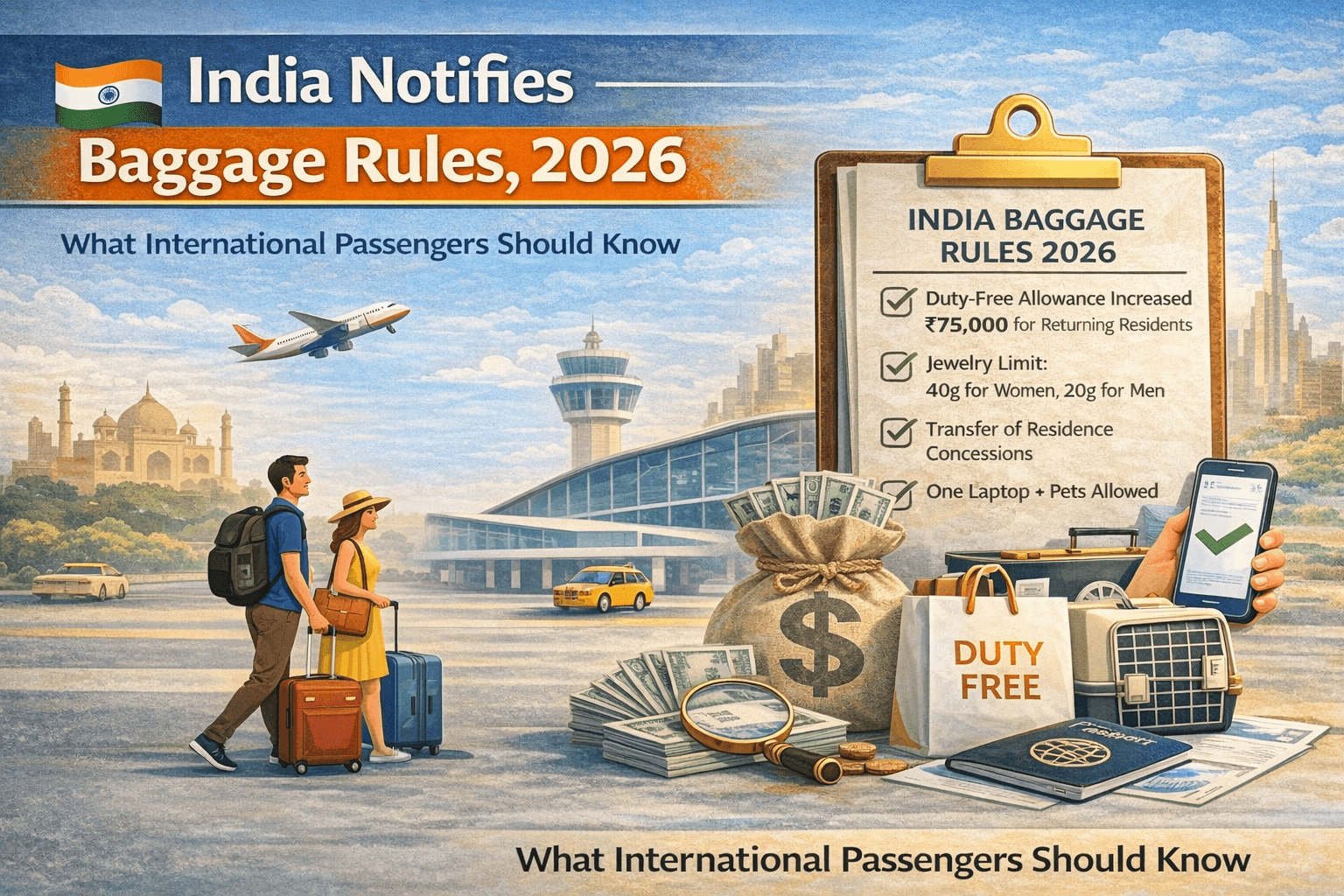


India Notifies Baggage Rules, 2026 – What International Passengers Should Know
The Government of India has notified the Baggage Rules, 2026 along with new Customs Baggage (Declaration and Processing) Regulations, 2026 and a consolidated customs circular. The changes update the earlier passenger baggage system and introduce revised procedures for international travellers arriving in India.
According to the Ministry of Finance announcement, the purpose of the new rules is to simplify customs clearance, increase transparency, and allow electronic and advance declarations by passengers.
The revised rules also adjust duty-free allowances and introduce several practical facilities for travellers based on current travel patterns and increased passenger movement.
Higher Duty-Free Allowance for Passengers
One of the major changes is the increase in general duty-free allowance for passengers arriving in India.
Under the new rules:
Residents returning to India are allowed goods up to ₹75,000 without duty
Tourists of Indian origin and certain foreign visitors also receive the same allowance
Foreign tourists receive a lower allowance of ₹25,000
Crew members have a smaller allowance
Passengers arriving through land borders do not receive a general duty-free allowance.
Transfer of Residence Benefits
The rules also revise concessions available to individuals shifting residence to India.
Duty-free import limits now depend on the period of stay abroad:
Up to 12 months – ₹1.5 lakh
1 to 2 years – ₹3 lakh
Above 2 years – ₹7.5 lakh
The government has also simplified the list of eligible items under this benefit.
Jewellery Allowances
Earlier, jewellery exemptions were based on value limits. The new rules instead prescribe weight-based allowances for returning residents and certain travellers after staying abroad for more than one year.
Female passengers: up to 40 grams
Other passengers: up to 20 grams
Temporary Import and Re-Import Facility
A new facility allows issuance of temporary import or export certificates for items carried temporarily into or out of India. This prevents detention of goods at the airport and enables smoother clearance on return travel.
Laptop and Pet Allowance
The rules now formally permit duty-free import of:
one laptop for passengers above 18 years of age
pets, subject to applicable procedures
Electronic Declarations and Simplified Processing
The new baggage declaration system introduces advance and electronic declaration options for passengers. The government intends to reduce manual processing and waiting time at airports and improve passenger facilitation.
The accompanying customs circular consolidates numerous earlier instructions into a single operational guidance document for officers, ensuring uniform implementation across customs formations.
Why These Changes Matter
The revised baggage rules reflect current travel conditions and higher passenger volumes. The government has indicated that the objective is smoother clearance, fewer delays, and a clearer customs process for travellers entering India.
For international travellers and returning residents, the changes mainly affect:
duty-free purchases abroad
relocation to India
jewellery carriage
electronic items and personal belongings
Conclusion
The Baggage Rules, 2026 modernise India’s passenger customs system. By increasing duty-free allowances, allowing electronic declarations, and simplifying procedures, the new framework aims to make airport clearance faster while maintaining customs control.
Travellers should review the revised allowances and declaration procedures before arriving in India to avoid duty demands or delays at customs.

India Notifies Baggage Rules, 2026 – What International Passengers Should Know
The Government of India has notified the Baggage Rules, 2026 along with new Customs Baggage (Declaration and Processing) Regulations, 2026 and a consolidated customs circular. The changes update the earlier passenger baggage system and introduce revised procedures for international travellers arriving in India.
According to the Ministry of Finance announcement, the purpose of the new rules is to simplify customs clearance, increase transparency, and allow electronic and advance declarations by passengers.
The revised rules also adjust duty-free allowances and introduce several practical facilities for travellers based on current travel patterns and increased passenger movement.
Higher Duty-Free Allowance for Passengers
One of the major changes is the increase in general duty-free allowance for passengers arriving in India.
Under the new rules:
Residents returning to India are allowed goods up to ₹75,000 without duty
Tourists of Indian origin and certain foreign visitors also receive the same allowance
Foreign tourists receive a lower allowance of ₹25,000
Crew members have a smaller allowance
Passengers arriving through land borders do not receive a general duty-free allowance.
Transfer of Residence Benefits
The rules also revise concessions available to individuals shifting residence to India.
Duty-free import limits now depend on the period of stay abroad:
Up to 12 months – ₹1.5 lakh
1 to 2 years – ₹3 lakh
Above 2 years – ₹7.5 lakh
The government has also simplified the list of eligible items under this benefit.
Jewellery Allowances
Earlier, jewellery exemptions were based on value limits. The new rules instead prescribe weight-based allowances for returning residents and certain travellers after staying abroad for more than one year.
Female passengers: up to 40 grams
Other passengers: up to 20 grams
Temporary Import and Re-Import Facility
A new facility allows issuance of temporary import or export certificates for items carried temporarily into or out of India. This prevents detention of goods at the airport and enables smoother clearance on return travel.
Laptop and Pet Allowance
The rules now formally permit duty-free import of:
one laptop for passengers above 18 years of age
pets, subject to applicable procedures
Electronic Declarations and Simplified Processing
The new baggage declaration system introduces advance and electronic declaration options for passengers. The government intends to reduce manual processing and waiting time at airports and improve passenger facilitation.
The accompanying customs circular consolidates numerous earlier instructions into a single operational guidance document for officers, ensuring uniform implementation across customs formations.
Why These Changes Matter
The revised baggage rules reflect current travel conditions and higher passenger volumes. The government has indicated that the objective is smoother clearance, fewer delays, and a clearer customs process for travellers entering India.
For international travellers and returning residents, the changes mainly affect:
duty-free purchases abroad
relocation to India
jewellery carriage
electronic items and personal belongings
Conclusion
The Baggage Rules, 2026 modernise India’s passenger customs system. By increasing duty-free allowances, allowing electronic declarations, and simplifying procedures, the new framework aims to make airport clearance faster while maintaining customs control.
Travellers should review the revised allowances and declaration procedures before arriving in India to avoid duty demands or delays at customs.
India Notifies Baggage Rules, 2026 – What International Passengers Should Know
The Government of India has notified the Baggage Rules, 2026 along with new Customs Baggage (Declaration and Processing) Regulations, 2026 and a consolidated customs circular. The changes update the earlier passenger baggage system and introduce revised procedures for international travellers arriving in India.
According to the Ministry of Finance announcement, the purpose of the new rules is to simplify customs clearance, increase transparency, and allow electronic and advance declarations by passengers.
The revised rules also adjust duty-free allowances and introduce several practical facilities for travellers based on current travel patterns and increased passenger movement.
Higher Duty-Free Allowance for Passengers
One of the major changes is the increase in general duty-free allowance for passengers arriving in India.
Under the new rules:
Residents returning to India are allowed goods up to ₹75,000 without duty
Tourists of Indian origin and certain foreign visitors also receive the same allowance
Foreign tourists receive a lower allowance of ₹25,000
Crew members have a smaller allowance
Passengers arriving through land borders do not receive a general duty-free allowance.
Transfer of Residence Benefits
The rules also revise concessions available to individuals shifting residence to India.
Duty-free import limits now depend on the period of stay abroad:
Up to 12 months – ₹1.5 lakh
1 to 2 years – ₹3 lakh
Above 2 years – ₹7.5 lakh
The government has also simplified the list of eligible items under this benefit.
Jewellery Allowances
Earlier, jewellery exemptions were based on value limits. The new rules instead prescribe weight-based allowances for returning residents and certain travellers after staying abroad for more than one year.
Female passengers: up to 40 grams
Other passengers: up to 20 grams
Temporary Import and Re-Import Facility
A new facility allows issuance of temporary import or export certificates for items carried temporarily into or out of India. This prevents detention of goods at the airport and enables smoother clearance on return travel.
Laptop and Pet Allowance
The rules now formally permit duty-free import of:
one laptop for passengers above 18 years of age
pets, subject to applicable procedures
Electronic Declarations and Simplified Processing
The new baggage declaration system introduces advance and electronic declaration options for passengers. The government intends to reduce manual processing and waiting time at airports and improve passenger facilitation.
The accompanying customs circular consolidates numerous earlier instructions into a single operational guidance document for officers, ensuring uniform implementation across customs formations.
Why These Changes Matter
The revised baggage rules reflect current travel conditions and higher passenger volumes. The government has indicated that the objective is smoother clearance, fewer delays, and a clearer customs process for travellers entering India.
For international travellers and returning residents, the changes mainly affect:
duty-free purchases abroad
relocation to India
jewellery carriage
electronic items and personal belongings
Conclusion
The Baggage Rules, 2026 modernise India’s passenger customs system. By increasing duty-free allowances, allowing electronic declarations, and simplifying procedures, the new framework aims to make airport clearance faster while maintaining customs control.
Travellers should review the revised allowances and declaration procedures before arriving in India to avoid duty demands or delays at customs.
India Notifies Baggage Rules, 2026 – What International Passengers Should Know
The Government of India has notified the Baggage Rules, 2026 along with new Customs Baggage (Declaration and Processing) Regulations, 2026 and a consolidated customs circular. The changes update the earlier passenger baggage system and introduce revised procedures for international travellers arriving in India.
According to the Ministry of Finance announcement, the purpose of the new rules is to simplify customs clearance, increase transparency, and allow electronic and advance declarations by passengers.
The revised rules also adjust duty-free allowances and introduce several practical facilities for travellers based on current travel patterns and increased passenger movement.
Higher Duty-Free Allowance for Passengers
One of the major changes is the increase in general duty-free allowance for passengers arriving in India.
Under the new rules:
Residents returning to India are allowed goods up to ₹75,000 without duty
Tourists of Indian origin and certain foreign visitors also receive the same allowance
Foreign tourists receive a lower allowance of ₹25,000
Crew members have a smaller allowance
Passengers arriving through land borders do not receive a general duty-free allowance.
Transfer of Residence Benefits
The rules also revise concessions available to individuals shifting residence to India.
Duty-free import limits now depend on the period of stay abroad:
Up to 12 months – ₹1.5 lakh
1 to 2 years – ₹3 lakh
Above 2 years – ₹7.5 lakh
The government has also simplified the list of eligible items under this benefit.
Jewellery Allowances
Earlier, jewellery exemptions were based on value limits. The new rules instead prescribe weight-based allowances for returning residents and certain travellers after staying abroad for more than one year.
Female passengers: up to 40 grams
Other passengers: up to 20 grams
Temporary Import and Re-Import Facility
A new facility allows issuance of temporary import or export certificates for items carried temporarily into or out of India. This prevents detention of goods at the airport and enables smoother clearance on return travel.
Laptop and Pet Allowance
The rules now formally permit duty-free import of:
one laptop for passengers above 18 years of age
pets, subject to applicable procedures
Electronic Declarations and Simplified Processing
The new baggage declaration system introduces advance and electronic declaration options for passengers. The government intends to reduce manual processing and waiting time at airports and improve passenger facilitation.
The accompanying customs circular consolidates numerous earlier instructions into a single operational guidance document for officers, ensuring uniform implementation across customs formations.
Why These Changes Matter
The revised baggage rules reflect current travel conditions and higher passenger volumes. The government has indicated that the objective is smoother clearance, fewer delays, and a clearer customs process for travellers entering India.
For international travellers and returning residents, the changes mainly affect:
duty-free purchases abroad
relocation to India
jewellery carriage
electronic items and personal belongings
Conclusion
The Baggage Rules, 2026 modernise India’s passenger customs system. By increasing duty-free allowances, allowing electronic declarations, and simplifying procedures, the new framework aims to make airport clearance faster while maintaining customs control.
Travellers should review the revised allowances and declaration procedures before arriving in India to avoid duty demands or delays at customs.