
This article explains the main compliance obligations created by the law and what organisations and families must now do in practice.

20 February, 2026
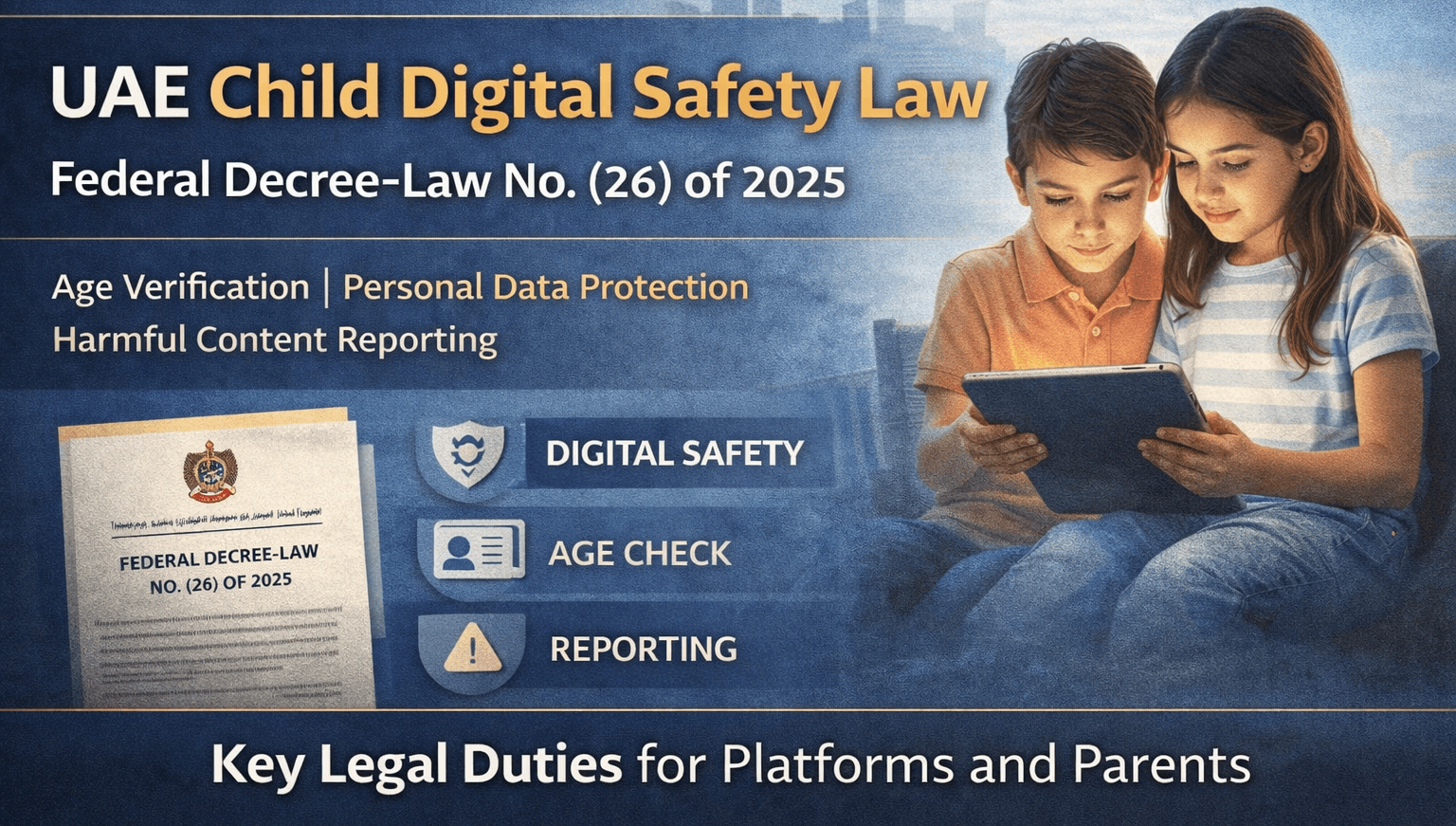
UAE Child Digital Safety Law: Key Compliance Duties Under Federal Decree-Law No. (26) of 2025

The UAE has introduced a specialised law to protect minors in digital environments through Federal Decree-Law No. (26) of 2025 on Child Digital Safety.
The legislation addresses how children interact with websites, applications, gaming platforms, social media services, and other online systems.

Unlike general cybercrime rules, this law focuses specifically on prevention. It requires digital platforms to design their services in a manner that reduces risk to minors and introduces clear legal responsibilities for service providers and guardians.

This article explains the main compliance obligations created by the law and what organisations and families must now do in practice.

Platform Classification and Safety Measures

The law adopts a risk-based approach toward online services.

Under Article (6), digital platforms are evaluated according to the level of risk they may pose to children. The assessment considers the type of service, interaction features, communication tools, and the likelihood of exposure to harmful content.

Following classification, Article (10) requires the platform to implement protective technical and organisational measures appropriate to its risk level. Higher-risk platforms must implement stronger controls, monitoring systems, and safeguards.

This effectively means a platform must now consider child safety at the design stage of its service, not only after complaints arise.

Protection of Children’s Personal Data

The law introduces stricter treatment for minors’ information.

According to Article (7), a service provider may not collect, process, or use a child’s personal data in a manner that may cause physical, psychological, or social harm. The obligation applies once the platform knows, or reasonably should know, that the user is a minor.

Children’s accounts, behaviour tracking, and profiling features must therefore be handled with additional care. Data practices acceptable for adults may not be acceptable for minors.

Age Verification Requirements

A key operational requirement under the law is age verification.

Under Article (8), digital service providers must implement appropriate mechanisms to verify a user’s age and prevent children from accessing content or services unsuitable for them.

This obligation affects:

  • social media platforms

  • gaming applications

  • video-sharing platforms

  • subscription and interactive services

A simple self-declaration by the user is unlikely to be sufficient where the service is commonly used by minors.

Reporting and Removal of Harmful Content

The law imposes active duties on online platforms.

Under Article (15), platforms must provide clear reporting mechanisms allowing harmful content affecting children to be reported. Once notified, the platform must take appropriate action and cooperate with competent authorities when required.

This may include removing content, restricting access, investigating the activity, and preserving relevant records.

The provision shifts responsibility from passive hosting to active protection.

Responsibilities of Parents and Guardians

The law also recognises that child safety online is not limited to technology companies.

Under Article (13), parents and guardians must supervise children’s digital usage and take reasonable measures to protect them from online risks. This includes monitoring usage and using available parental control tools where necessary.

The legislation therefore treats child protection as a shared responsibility between platforms and families.

Penalties and Regulatory Enforcement

Compliance is enforceable.

Under Article (16), authorities may impose penalties and regulatory action against entities that fail to implement the required safeguards or fail to respond appropriately to risks affecting minors.

For organisations, this means child digital safety is now a regulatory compliance matter, not merely a best-practice recommendation.

Why This Matters

The law changes how online services must operate in the UAE. Platforms must now consider children as a protected category of users and implement preventive safety measures. Companies offering applications, educational technology, gaming services, communication platforms, or interactive websites should review their systems, privacy settings, and moderation procedures.

Parents and guardians should also understand that supervision is now a recognised legal duty, not only a precaution.

Conclusion

Businesses operating digital platforms in the UAE should review their user policies, privacy practices, reporting tools, and age-control mechanisms to ensure alignment with Federal Decree-Law No. (26) of 2025 on Child Digital Safety. Early compliance reduces regulatory risk and demonstrates responsible operation in the UAE’s digital environment.

UAE Child Digital Safety Law: Key Compliance Duties Under Federal Decree-Law No. (26) of 2025

The UAE has introduced a specialised law to protect minors in digital environments through Federal Decree-Law No. (26) of 2025 on Child Digital Safety.
The legislation addresses how children interact with websites, applications, gaming platforms, social media services, and other online systems.

Unlike general cybercrime rules, this law focuses specifically on prevention. It requires digital platforms to design their services in a manner that reduces risk to minors and introduces clear legal responsibilities for service providers and guardians.

This article explains the main compliance obligations created by the law and what organisations and families must now do in practice.

Platform Classification and Safety Measures

The law adopts a risk-based approach toward online services.

Under Article (6), digital platforms are evaluated according to the level of risk they may pose to children. The assessment considers the type of service, interaction features, communication tools, and the likelihood of exposure to harmful content.

Following classification, Article (10) requires the platform to implement protective technical and organisational measures appropriate to its risk level. Higher-risk platforms must implement stronger controls, monitoring systems, and safeguards.

This effectively means a platform must now consider child safety at the design stage of its service, not only after complaints arise.

Protection of Children’s Personal Data

The law introduces stricter treatment for minors’ information.

According to Article (7), a service provider may not collect, process, or use a child’s personal data in a manner that may cause physical, psychological, or social harm. The obligation applies once the platform knows, or reasonably should know, that the user is a minor.

Children’s accounts, behaviour tracking, and profiling features must therefore be handled with additional care. Data practices acceptable for adults may not be acceptable for minors.

Age Verification Requirements

A key operational requirement under the law is age verification.

Under Article (8), digital service providers must implement appropriate mechanisms to verify a user’s age and prevent children from accessing content or services unsuitable for them.

This obligation affects:

  • social media platforms

  • gaming applications

  • video-sharing platforms

  • subscription and interactive services

A simple self-declaration by the user is unlikely to be sufficient where the service is commonly used by minors.

Reporting and Removal of Harmful Content

The law imposes active duties on online platforms.

Under Article (15), platforms must provide clear reporting mechanisms allowing harmful content affecting children to be reported. Once notified, the platform must take appropriate action and cooperate with competent authorities when required.

This may include removing content, restricting access, investigating the activity, and preserving relevant records.

The provision shifts responsibility from passive hosting to active protection.

Responsibilities of Parents and Guardians

The law also recognises that child safety online is not limited to technology companies.

Under Article (13), parents and guardians must supervise children’s digital usage and take reasonable measures to protect them from online risks. This includes monitoring usage and using available parental control tools where necessary.

The legislation therefore treats child protection as a shared responsibility between platforms and families.

Penalties and Regulatory Enforcement

Compliance is enforceable.

Under Article (16), authorities may impose penalties and regulatory action against entities that fail to implement the required safeguards or fail to respond appropriately to risks affecting minors.

For organisations, this means child digital safety is now a regulatory compliance matter, not merely a best-practice recommendation.

Why This Matters

The law changes how online services must operate in the UAE. Platforms must now consider children as a protected category of users and implement preventive safety measures. Companies offering applications, educational technology, gaming services, communication platforms, or interactive websites should review their systems, privacy settings, and moderation procedures.

Parents and guardians should also understand that supervision is now a recognised legal duty, not only a precaution.

Conclusion

Businesses operating digital platforms in the UAE should review their user policies, privacy practices, reporting tools, and age-control mechanisms to ensure alignment with Federal Decree-Law No. (26) of 2025 on Child Digital Safety. Early compliance reduces regulatory risk and demonstrates responsible operation in the UAE’s digital environment.

UAE Child Digital Safety Law: Key Compliance Duties Under Federal Decree-Law No. (26) of 2025

The UAE has introduced a specialised law to protect minors in digital environments through Federal Decree-Law No. (26) of 2025 on Child Digital Safety.
The legislation addresses how children interact with websites, applications, gaming platforms, social media services, and other online systems.

Unlike general cybercrime rules, this law focuses specifically on prevention. It requires digital platforms to design their services in a manner that reduces risk to minors and introduces clear legal responsibilities for service providers and guardians.

This article explains the main compliance obligations created by the law and what organisations and families must now do in practice.

Platform Classification and Safety Measures

The law adopts a risk-based approach toward online services.

Under Article (6), digital platforms are evaluated according to the level of risk they may pose to children. The assessment considers the type of service, interaction features, communication tools, and the likelihood of exposure to harmful content.

Following classification, Article (10) requires the platform to implement protective technical and organisational measures appropriate to its risk level. Higher-risk platforms must implement stronger controls, monitoring systems, and safeguards.

This effectively means a platform must now consider child safety at the design stage of its service, not only after complaints arise.

Protection of Children’s Personal Data

The law introduces stricter treatment for minors’ information.

According to Article (7), a service provider may not collect, process, or use a child’s personal data in a manner that may cause physical, psychological, or social harm. The obligation applies once the platform knows, or reasonably should know, that the user is a minor.

Children’s accounts, behaviour tracking, and profiling features must therefore be handled with additional care. Data practices acceptable for adults may not be acceptable for minors.

Age Verification Requirements

A key operational requirement under the law is age verification.

Under Article (8), digital service providers must implement appropriate mechanisms to verify a user’s age and prevent children from accessing content or services unsuitable for them.

This obligation affects:

  • social media platforms

  • gaming applications

  • video-sharing platforms

  • subscription and interactive services

A simple self-declaration by the user is unlikely to be sufficient where the service is commonly used by minors.

Reporting and Removal of Harmful Content

The law imposes active duties on online platforms.

Under Article (15), platforms must provide clear reporting mechanisms allowing harmful content affecting children to be reported. Once notified, the platform must take appropriate action and cooperate with competent authorities when required.

This may include removing content, restricting access, investigating the activity, and preserving relevant records.

The provision shifts responsibility from passive hosting to active protection.

Responsibilities of Parents and Guardians

The law also recognises that child safety online is not limited to technology companies.

Under Article (13), parents and guardians must supervise children’s digital usage and take reasonable measures to protect them from online risks. This includes monitoring usage and using available parental control tools where necessary.

The legislation therefore treats child protection as a shared responsibility between platforms and families.

Penalties and Regulatory Enforcement

Compliance is enforceable.

Under Article (16), authorities may impose penalties and regulatory action against entities that fail to implement the required safeguards or fail to respond appropriately to risks affecting minors.

For organisations, this means child digital safety is now a regulatory compliance matter, not merely a best-practice recommendation.

Why This Matters

The law changes how online services must operate in the UAE. Platforms must now consider children as a protected category of users and implement preventive safety measures. Companies offering applications, educational technology, gaming services, communication platforms, or interactive websites should review their systems, privacy settings, and moderation procedures.

Parents and guardians should also understand that supervision is now a recognised legal duty, not only a precaution.

Conclusion

Businesses operating digital platforms in the UAE should review their user policies, privacy practices, reporting tools, and age-control mechanisms to ensure alignment with Federal Decree-Law No. (26) of 2025 on Child Digital Safety. Early compliance reduces regulatory risk and demonstrates responsible operation in the UAE’s digital environment.

UAE Child Digital Safety Law: Key Compliance Duties Under Federal Decree-Law No. (26) of 2025

The UAE has introduced a specialised law to protect minors in digital environments through Federal Decree-Law No. (26) of 2025 on Child Digital Safety.
The legislation addresses how children interact with websites, applications, gaming platforms, social media services, and other online systems.

Unlike general cybercrime rules, this law focuses specifically on prevention. It requires digital platforms to design their services in a manner that reduces risk to minors and introduces clear legal responsibilities for service providers and guardians.

This article explains the main compliance obligations created by the law and what organisations and families must now do in practice.

Platform Classification and Safety Measures

The law adopts a risk-based approach toward online services.

Under Article (6), digital platforms are evaluated according to the level of risk they may pose to children. The assessment considers the type of service, interaction features, communication tools, and the likelihood of exposure to harmful content.

Following classification, Article (10) requires the platform to implement protective technical and organisational measures appropriate to its risk level. Higher-risk platforms must implement stronger controls, monitoring systems, and safeguards.

This effectively means a platform must now consider child safety at the design stage of its service, not only after complaints arise.

Protection of Children’s Personal Data

The law introduces stricter treatment for minors’ information.

According to Article (7), a service provider may not collect, process, or use a child’s personal data in a manner that may cause physical, psychological, or social harm. The obligation applies once the platform knows, or reasonably should know, that the user is a minor.

Children’s accounts, behaviour tracking, and profiling features must therefore be handled with additional care. Data practices acceptable for adults may not be acceptable for minors.

Age Verification Requirements

A key operational requirement under the law is age verification.

Under Article (8), digital service providers must implement appropriate mechanisms to verify a user’s age and prevent children from accessing content or services unsuitable for them.

This obligation affects:

  • social media platforms

  • gaming applications

  • video-sharing platforms

  • subscription and interactive services

A simple self-declaration by the user is unlikely to be sufficient where the service is commonly used by minors.

Reporting and Removal of Harmful Content

The law imposes active duties on online platforms.

Under Article (15), platforms must provide clear reporting mechanisms allowing harmful content affecting children to be reported. Once notified, the platform must take appropriate action and cooperate with competent authorities when required.

This may include removing content, restricting access, investigating the activity, and preserving relevant records.

The provision shifts responsibility from passive hosting to active protection.

Responsibilities of Parents and Guardians

The law also recognises that child safety online is not limited to technology companies.

Under Article (13), parents and guardians must supervise children’s digital usage and take reasonable measures to protect them from online risks. This includes monitoring usage and using available parental control tools where necessary.

The legislation therefore treats child protection as a shared responsibility between platforms and families.

Penalties and Regulatory Enforcement

Compliance is enforceable.

Under Article (16), authorities may impose penalties and regulatory action against entities that fail to implement the required safeguards or fail to respond appropriately to risks affecting minors.

For organisations, this means child digital safety is now a regulatory compliance matter, not merely a best-practice recommendation.

Why This Matters

The law changes how online services must operate in the UAE. Platforms must now consider children as a protected category of users and implement preventive safety measures. Companies offering applications, educational technology, gaming services, communication platforms, or interactive websites should review their systems, privacy settings, and moderation procedures.

Parents and guardians should also understand that supervision is now a recognised legal duty, not only a precaution.

Conclusion

Businesses operating digital platforms in the UAE should review their user policies, privacy practices, reporting tools, and age-control mechanisms to ensure alignment with Federal Decree-Law No. (26) of 2025 on Child Digital Safety. Early compliance reduces regulatory risk and demonstrates responsible operation in the UAE’s digital environment.

Talk to us, solve your problems

Talk to us, solve your problems

Talk to us, solve your problems