Learn about the UAE’s new packaged food rules on sodium, sugar and fat, phased compliance deadlines, penalties and what food businesses need to do.
13th October, 2026
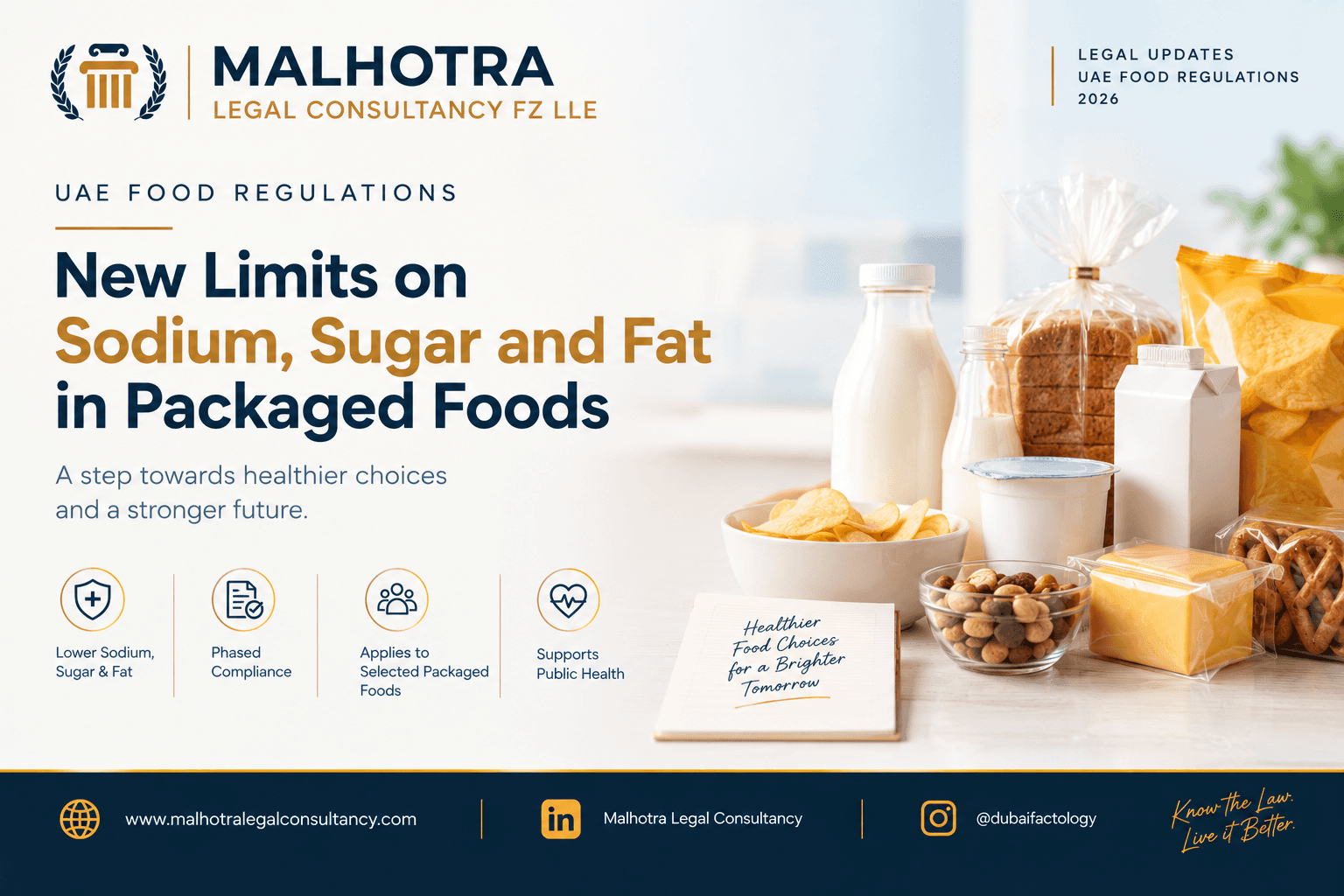
UAE Introduces New Sodium, Sugar and Fat Limits for Packaged Foods: What Businesses Need to Know
The UAE has announced new requirements to gradually reduce sodium, sugar and fat levels in selected packaged food products. On 6 October 2026, the Emirates News Agency (WAM) reported that the Ministry of Health and Prevention (MoHAP) had started implementing the resolution, introducing maximum permitted ingredient levels for specified food categories.
The requirements are intended to improve the nutritional quality of commonly consumed foods and support national efforts to address obesity and other non-communicable diseases associated with unhealthy diets.
The changes are relevant to food manufacturers, importers, distributors, supermarkets and other establishments handling the affected products. Businesses will need to identify the applicable limits, review product specifications and plan for phased compliance.
However, the formal resolution number and effective date could not be independently verified from the published legal material reviewed for this article. Businesses should confirm these details with MoHAP or the relevant competent authority before calculating their compliance deadlines.
What Are the UAE’s New Packaged Food Requirements?
According to MoHAP’s announcement, the resolution establishes maximum permitted levels of specified ingredients in selected packaged foods manufactured locally or imported into the UAE.
The limits are measured per 100 grams of the relevant product. They vary according to the food category and are intended to decrease in stages rather than require every affected product to change immediately.
The requirements cover relevant activities throughout the food supply chain, including manufacturing, processing, packaging, importing, storage, distribution, display and sale. Food establishments operating in free zones are also included where they handle the covered products.
Products manufactured or imported exclusively for direct export or onward export outside the UAE are excluded, unless they are traded within the country.
Which Food Products Are Covered?
The announced requirements divide the selected products into two groups, each with a different initial compliance period.
1. Bread and Bakery Products
The requirements cover specified leavened bread and flat bread products.
For leavened bread, the announced first-phase limits are:
Sodium: 444 mg per 100 g
Total sugars: 6 g per 100 g
Total fat: 8.4 g per 100 g
The final limits are scheduled to reduce these amounts to 370 mg of sodium, 5 g of total sugars and 7 g of total fat per 100 g.
For flat bread, the sodium limit is set to decrease from 384 mg to 320 mg per 100 g. The total-sugar limit decreases from 6 g to 5 g, while the total-fat limit decreases from 8.4 g to 7 g per 100 g.
Manufacturers may therefore need to review their recipes, ingredients and production processes to meet the relevant limits.
2. Sweetened Milk Drinks and Milk Alternatives
The requirements also cover specified sweetened milk drinks and milk alternatives, including oat, almond and soy drinks.
For these products, the maximum total-sugar content decreases from 9.6 g to 8 g per 100 g.
For sweetened or flavoured yoghurt and laban, the maximum total-sugar content decreases from 12 g to 10 g per 100 g.
Manufacturers and importers should identify which product categories apply to their goods and assess whether reformulation or changes to their sourcing arrangements may be necessary.
3. Salty Snacks
Selected salty snacks will be subject to lower sodium limits.
The announced changes include:
Potato chips and specified extruded snacks: 564 mg to 470 mg of sodium per 100 g.
Salted crackers: 696 mg to 580 mg per 100 g.
Pretzels: 912 mg to 760 mg per 100 g.
Salted nuts and seeds: 336 mg to 280 mg per 100 g.
These are category-specific maximum levels. They should not be treated as one general sodium limit applying to every packaged food product sold in the UAE.
4. Processed Cheese
Processed cheese products fall under the second group and have a longer initial compliance period.
For spreadable processed cheese, the announced sodium limit decreases from 864 mg to 720 mg per 100 g.
For other processed cheese products, it decreases from 1,200 mg to 1,000 mg per 100 g.
Businesses should verify the classification of each product before deciding which limit and compliance period apply.
What Are the Compliance Deadlines?
The announced requirements use a phased approach, giving businesses different periods to meet the initial limits while requiring further reductions towards the final targets.
Requirement | Announced timeline |
|---|---|
Group 1 products, including specified bread, sweetened dairy products and salty snacks | Initial limits within a maximum of 9 months from the resolution’s effective date |
Group 2 products, including processed cheese | Initial limits within a maximum of 2 years and 3 months from the effective date |
Eligible existing stock | May remain on sale for up to 1 year from the effective date, or until expiry, whichever comes first |
Final ingredient limits | No later than 31 December 2030 |
Applications for certain exceptions to initial limits | Within 30 days from the effective date |
Important: The periods above are calculated from the resolution’s effective date, not automatically from WAM’s announcement on 6 October 2026. Because the signed instrument and its effective date have not been verified in the sources reviewed, businesses should confirm the applicable dates before setting internal compliance deadlines.
The transition period for eligible existing stock is also limited. It does not allow non-compliant products to remain on sale indefinitely until 2030.
Can Businesses Apply for an Exception?
The announcement describes a limited exception process for businesses that would need to reduce a targeted ingredient by more than 20% of its established content to meet the initial-phase limit.
Eligible establishments may apply to MoHAP within 30 days from the resolution’s effective date. The announced supporting information includes:
Technical data relating to the product.
Information from the registered nutrition label.
Test results issued by an accredited laboratory.
A commitment to reduce the targeted ingredient by at least 20% during the first-phase period.
The exception does not remove the obligation to meet the final limits or extend the final deadline beyond 31 December 2030.
As the application period may be short, affected businesses should verify the formal requirements and prepare relevant product records promptly.
What Penalties Could Businesses Face?
According to the MoHAP announcement, administrative penalties for violations may include:
A warning.
An administrative fine ranging from AED 5,000 to AED 500,000.
Closure of the establishment for up to six months, which may be renewed.
Cancellation of the establishment’s licence or approval, in coordination with the relevant licensing authority.
The applicable penalty depends on factors such as the seriousness of the violation, the circumstances and whether it is repeated.
The announcement also states that the Cabinet will issue the list of administrative violations and penalties on the proposal of the Minister of Health and Prevention, following coordination with the relevant authorities. Businesses should therefore verify the relevant implementing instruments and penalty schedule before making legal assessments.
Federal and local health authorities and other competent authorities are expected to monitor compliance in coordination with MoHAP. Establishments may need to provide product information, nutrition records and other documentation needed to verify compliance.
What Should Food Businesses Do Now?
Although the requirements are being introduced in phases, businesses should begin assessing their exposure rather than wait until the final deadline.
Review the Product Portfolio
Identify packaged products that may fall within the specified categories. Confirm the relevant classification for bread, dairy products, milk alternatives, snacks and processed cheese.
Check Nutritional Specifications
Compare the sodium, total-sugar and total-fat content of affected products against the announced first-phase limits. Use reliable product specifications, nutrition labels and laboratory results where appropriate.
Coordinate with Suppliers
Importers, distributors, supermarkets and restaurants should contact manufacturers and suppliers to establish which products are affected and how revised formulations or replacement products will be supplied.
Review Inventory and Expiry Dates
Identify existing stock that may qualify for the transition period. Maintain records of manufacturing or import dates and expiry dates, and confirm the applicable rules before relying on the permitted sale period.
Maintain Compliance Records
Keep product specifications, nutrition labels, laboratory reports, supplier communications and reformulation records organised and accessible. These records may help demonstrate compliance if requested by the relevant authority.
Confirm the Formal Legal Requirements
Obtain or verify the signed resolution, its formal number, effective date, applicable product schedules and any implementing decisions. These details are particularly important for calculating deadlines, assessing exceptions and understanding enforcement requirements.
What Does This Mean for Consumers?
Consumers may gradually see changes in the nutritional composition of selected packaged foods as manufacturers adjust their products.
However, compliance with a particular sodium, sugar or fat limit does not automatically mean that a product is healthy in every respect. Portion size and the product’s overall nutritional composition remain relevant.
The announced requirements are one part of the UAE’s broader public-health efforts to encourage healthier food choices and reduce risks associated with unhealthy diets.
Conclusion
The UAE’s announced limits on sodium, sugar and fat in selected packaged foods signal a significant compliance development for businesses across the food supply chain.
Manufacturers may need to reformulate products, while importers, distributors, retailers and food-service businesses should review their product categories, supplier arrangements and inventory practices. The phased approach provides time for adjustments, but the final limits are scheduled to be achieved by 31 December 2030.
For businesses, the immediate priority is to identify affected products, assess their current nutritional composition and verify the formal resolution and effective date before calculating individual deadlines.
Malhotra Legal Consultancy can assist businesses with regulatory research, compliance reviews and the assessment of legal obligations relevant to their operations in the UAE. Any assessment should be based on the applicable signed legislation and implementing decisions.
Read more articles
UAE Food Regulations 2026: New Sodium, Sugar and Fat Limits
Learn about the UAE’s new packaged food rules on sodium, sugar and fat, phased compliance deadlines, penalties and what food businesses need to do.
13th October, 2026

UAE Pillar Two Information Return 2026: New Filing Requirements for Multinational Businesses
The UAE has issued Ministerial Decision No. 133 of 2026 setting out who must file the Pillar Two Information Return. Learn who is covered, what the rules require and when they apply.
01 October, 2026

UAE Small Business Relief Extended to 2029: What UAE Businesses Need to Know
UAE Small Business Relief has been extended to 31 December 2029. Learn who qualifies, the AED 3 million revenue threshold, exclusions, tax filing requirements and what businesses should do.
28 September, 2026